

Last Updated: October 15, 2026
Why Nursery Decor That Grows Up Can Make Your Life Easier and Richer
It can be tricky to imagine creating a space that grows. Not everyone is going to feel the need to... It can be tons of fun to go all out each season of a child's life and make a room special to that moment in time. But for some of us we don't have the privilege of this kind of extravagance or simply like to live out lives in a more gentle way that considers what can be reused or adjusted all the while continuously holding and reflecting that we are noticing the special individual our child is growing into. I think the easiest way to achieve a nursery that grows as our child does is to begin with nursery decor that is a quiet foundation.
Not because a child’s room should be blank or careful, but because children change so quickly. One day you are choosing a crib sheet before you know who this small person will be. Then, somehow, they have a favorite animal, a stack of books they insist on reading again, a color they love, and their own little ideas about what belongs in their room.
A calm, neutral base gives all of those things somewhere to land.
It can stay steady while the room gathers more personality over time: art, a favorite pillow, a new bookcase, a treasured object, a poster, a strange little collection of rocks. The room does not have to be redesigned from the beginning every time your child grows into a new version of themselves.
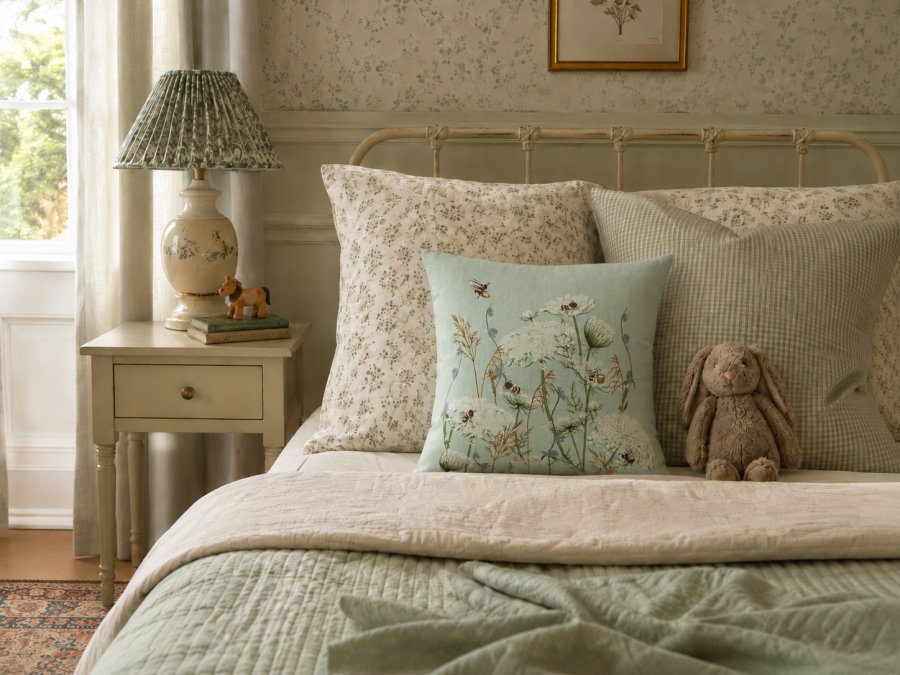
Choosing Timeless Nursery Decor
What Makes a Design Feel Timeless
A design feels timeless isn't even asking what is current right now, it doesn't depend on this year's color or character trend to feel right.
I notice this most in old rooms. A cottage bedroom with pale walls and simple furniture doesn't look dated from 1995. It looks like it could exist in any decade. Restraint ages well.
Timeless design usually has these things in common:
- It draws from nature instead of pop culture
- The colors are grayed or less saturated, not necessarily light, sometime dark too.
- The patterns feel handmade, not mass-produced
- It leaves room for a child to grow into it
Think about a room with forest animals instead of licensed characters. A wallpaper with wildflowers instead of branded themes. These things don't feel trapped in a moment. They feel like they're waiting to be discovered again.
The challenge, and I'll be honest, is that trendy is often easier. You can walk into any store and see what's popular right now. Timeless requires you to slow down and ask: will I still love this in five years?
At At the Cottage, I think about this constantly. My designs start as hand-drawn illustrations, rooted in imagery that has felt magical to children for generations: woodland creatures, wildflowers, gentle patterns.
Color Palettes That Don't Feel Dated in Three Years
Soft neutrals are your friend here. Creams, beiges, pale grays, warm whites. These colors have been beautiful for decades, and they'll still be beautiful in decades to come.
The trick is choosing neutrals that feel intentional, not boring. A pale sage isn't the same as beige. When you choose thoughtfully, a neutral room doesn't feel empty. It feels calm.
I've noticed that rooms with strong accent colors can feel dated faster. Not always. But often. The safer approach is to keep walls neutral and bring color through textiles, art, and accessories. That way, when your child's tastes change, you can refresh without replacing the "big items". For example, the wallpaper we create at At the Cottage tend toward these quieter palettes.

Wildflower Meadow Wallpaper
Build a Neutral Base That Does Not Feel Empty
When I say “neutral,” I do not mean every room has to be beige.
I mean choosing the quieter parts of the room the walls, larger furniture, rug, curtains, or storage with enough softness and flexibility that they can stay while the more playful layers change around them.
Warm cream, weathered taupe, soft gray, natural wood, greige pinks, faded blue, gentle green, and earthy brown can all work as a neutral foundation. They can feel like cloudy-day light, old painted wood, lake water, linen, bark, a flower in the meadow or moss. They are usually less saturated, calm enough to live with for years, but not so empty that the room loses its personality.
A few neutral foundations I love:
- Warm cream walls with wood furniture and mossy green accents
- Weathered taupe with faded blue, old brass, and storybook art
- Soft gray-blue aqua with warm wood, gingham, and a little rust or gold
- Earth brown with mossy green, botanical details, and royal blue pops
- Pale green with natural textiles, old books, and small floral touches
The neutral base is not the whole room. It is the ground beneath the interesting things.
Let Personality Arrive in Layers
This is where I think a room starts to become truly personal.
A child may begin with a woodland animal print because you love the woods. Later, they may become the child who is deeply devoted to foxes, whales, music, outer space, bugs, maps, or a very particular shade of blue. You can let those things arrive without having to erase everything that came before.
Art, books, textiles, small furniture, and objects with stories are wonderful places to add personality because they can move, change, and grow along with the child.
I would rather choose one illustration you genuinely love than a roomful of things that all match for the moment. A musical fox, a sailing whale, a favorite vintage book, a handmade quilt, or a small brass frame can all add more to a room than another generic accessory ever could.
The room can keep a sense of continuity while still making room for the child inside it.
A Nursery That Grows With Baby: Furniture and Layout
Choose Furniture That Can Keep Doing Its Job
A nursery does not need to be filled with furniture that only works for one season.
A dresser can begin its life holding tiny socks and diapers, then hold bigger clothes, school papers, art supplies, or treasures later on. A comfortable chair can be used for nighttime feeds, then story time, then a quiet reading corner. Shelves can hold swaddles for a while, then picture books and collections of rocks.
I like pieces with good bones: useful storage, sturdy construction, and a shape that does not feel overly babyish. That might be a simple wood dresser, a thrifted chair, a practical bookshelf, or a crib that can become a toddler bed if that works for your family.
You do not need to buy every “convertible” thing on the market. The real question is simpler: could this keep being useful when this particular season is over?
Look for:
- Solid wood construction (it lasts longer)
- Simple, clean designs (they age better)
- Neutral finishes (they work in any room) and it can be fun to paint them
- Pieces that serve multiple purposes
When you choose storage, think about:
- Will this piece work in a different room later?
- Does it look grown-up enough to transition?
- Are the materials sturdy enough to last years?
- Can it hold different things at different stages?
Wall Decor and Textiles: Building Layers You Can Refresh
Walls and textiles are some of the easiest places to let a room grow. A wallpaper like the Wildflower Meadow Wallpapercan anchor a room, setting the mood and giving the space a sense of intention. But here's what I love: it's not permanent.
A neutral wall color or a wallpaper you love can stay in place while other things shift around it. Woodland Lullaby Wallpaper, for example, is designed to be a statement piece, beautiful enough to carry a room on its own. But it's not so specific that it only works in a nursery. It can begin in a nursery and still feel at home beside a child’s changing book collection, a different bed, or a new piece of art.
Textiles, curtains, rugs, bedding, are even easier to refresh. A nursery might have soft, gentle fabrics. As your child grows, you can keep the same curtains or swap them for something they choose.
The approach we take is this: choose one or two statement pieces for your walls. Let those be timeless.
Think about:
- Using wallpaper that speaks to your soul
- Choosing art prints you can rotate or replace
- Selecting curtains in neutral fabrics
- Adding pillows and blankets in colors that coordinate but aren't matchy
For example, art prints can move. A small print above a changing table might later hang over a reading chair, beside a desk, or in a hallway where everyone still gets to see it.
You might keep the curtains and bring in a new quilt. Keep the wallpaper and add a favorite pillow to a reading chair. Repeat a color from an art print in a rug, lamp, or little basket.

Storybook Bees Art Print
Choosing Less Wasteful Nursery Decor
I care about beauty, but I also think it matters how much we ask our homes to throw away.
There is a whole industry built around the idea that every stage of childhood requires a completely new room. Children do grow and their needs do change, but a room does not need to become disposable because it changes.
A neutral base can help with this. When the walls, furniture, and larger pieces are chosen with some staying power, you can make smaller changes as your child grows instead of replacing everything. Add a new art print. Move a shelf. Change the bedding. Let a child choose one special thing.
For me, choosing more thoughtfully means buying less, choosing longer, and allowing objects to be used enough to become part of a family’s story.
That might mean:
- Choosing a dresser instead of furniture that only works as a changing table
- Buying a washable rug or removable pillow cover because children spill and drool and leave mysterious brown spots everywhere
- Reusing art in another room as a child grows
- Mending, repainting, recovering, or repurposing something before replacing it
- Looking for vintage, thrifted, inherited, or handmade pieces with good bones
- Choosing a few meaningful new things instead of filling a room with short-lived trends
Made-to-order production matters to me for the same reason. I make my home decor after someone has decided it belongs in their home, rather than producing piles of things and hoping they find a place to go. It is one small way to avoid unnecessary inventory and make fewer things that never become useful to anyone.
No purchase is without impact. But I do think choosing things we will use, care for, mend, move, or pass along is a kinder place to begin.
Choosing Pieces Worth Keeping
“Heirloom quality” does not only mean expensive, delicate, or old-fashioned.
To me, it means something is made well enough to be used, personal enough to matter, and useful enough that it does not become irrelevant the moment a trend changes. It might be a handmade quilt, a vintage chair, an art print, a favorite animal pillow, or a piece that reflects a specific interest in the family.
I make my own home decor to order because I want it to begin its life after someone has chosen it. It feels a little more like someone sewing something for a particular child or special occasion than pulling one identical item from a huge stack.
That kind of choice can make a room feel more personal from the beginning.
A child may choose the fox because they love foxes. A parent who played music may see part of their own life in a little animal orchestra. A family who loves old maps and faraway places may be drawn to a whale carrying a ship.
Those connections are what make a room feel worth keeping.
How to Preserve Nursery Art for Generations
This is the part that gets me. The idea that something you choose for your child's room might still be there when they have children of their own.
It's not just about durability, though that matters. It's about choosing art and decor you'd actually want to keep, that you'd want to pass down.
Preservation starts with the materials. Art prints on quality paper, wallpaper that doesn't fade in sunlight, pillows with quality handmade stitches and made from natural fabrics that age well. These things cost a little more upfront.
It also means thinking about care. Keeping things out of direct sunlight. Storing items properly if you move. Choosing materials that can be cleaned gently without falling apart.
That's why we focus on heirloom-quality pieces at At the Cottage. Wallpaper printed on durable materials. Art prints designed to last. Pillows hand stitched after ordered and made from thick fabrics that soften with age instead of falling apart.

Chipmunk on a Summer's Day Pillow
The Nursery-to-Toddler Room Transition
The transition from nursery to toddler room does not have to be dramatic.
Often, it begins with small signs: a child wants to choose their own book, starts noticing a particular picture, needs lower shelves, or has an opinion about which animal belongs on the bed. Those are gentle invitations to let the room become a little more theirs.
You might:
- Move a beloved print where they can see it more easily
- Add a child-sized chair, table, or low bookshelf
- Let them choose one new pillow, art print, or small basket
- Replace nursery-only storage with shelves for books and toys
- Keep the neutral base while adding a few things that reflect their growing interests
A child does not need to make every decorating decision. But they can have a little voice in the room without needing to start all over.
Making a Room That Can Hold a Family’s Story
The rooms we make for our children are temporary, and they are also part of the memory of growing up. But the room can evolve. It doesn't disappear. A place where the books can spill a little, the chair gets sat in, the quilt softens, and a favorite picture stays long enough to become familiar.
If you chose well in the beginning, if your walls are a soft neutral or feature timeless wallpaper, if your furniture is simple and sturdy, the bones are already there.
Then gather the things that make the room feel alive: the art, the stories, the colors, the useful pieces, the old things, the handmade things, and the little clues about who your child is becoming and do a gentle refresh.
A gentle refresh might look like this:
- Swap out the crib for a toddler bed (if you have a convertible crib, you're already set)
- Remove the changing table or repurpose it as storage
- Add a small table and chairs at their height
- Hang new art at their eye level
- Bring in pillows and blankets they can choose
- Keep the wallpaper, but add a growth chart or a small gallery wall
Let the room grow from there. I think what matters most is that your child feels seen in the transition. They're not a baby anymore. The room shouldn't pretend they are.
Frequently Asked Questions
How do you decorate a nursery that grows with your child?
Start with a calming neutral base: flexible wall colors, useful furniture, natural materials, and storage that can change jobs. Then add personality through art, textiles, books, and small decor that can be moved, refreshed, or kept as your child grows.
What makes nursery decor actually timeless instead of trendy?
Lasting decor reflects a real interest, memory, or feeling rather than a short-lived trend. Nature, music, favorite animals, old stories, handmade details, and collected objects can all grow with a child when they have personal meaning.
How can I preserve nursery art for generations?
Choose fewer pieces that can stay useful longer. Look for sturdy furniture, washable textiles, art that can move into another room, and items you can mend, reuse, donate, or pass along. A flexible neutral base also means you can refresh a room without replacing everything.
What's the best way to transition a nursery into a toddler room?
Keep the parts of the room that still feel right, then make a few practical changes. Remove nursery-only items, add accessible book storage or a small table, and introduce one or two details that reflect your child’s growing interests.
Do timeless nurseries have to be neutral?
No. A neutral base can make a room flexible, but the room itself can be richly colored, patterned, whimsical, and full of personality. Think of the neutral pieces as the ground beneath the story, not the whole story.