

Last Updated: September 16, 2026
What Makes Artist Designed Wallpaper Different
My son collects rocks, he has for years and I don’t think it’s ending anytime soon. Every day after school he empty’s his pockets and backpack onto the kitchen table. I love listening to the reasons each one came home with him that day, and I also stand there taking deep breaths while I try to remember that dinner prep can wait 5 more minutes, then dinner is late again. But I think about those rocks when I think about why I choose artist designed wallpaper. That carefully curated collection is a record of his day, a memory, a friend…..his humanity.
Artist designed wallpaper is created by a named artist whose original work and point of view shape the pattern from first sketch to final print. At the Cottage exists because I kept painting the same small things: moss, moths, a fox playing a viola, etc... The noticing and collecting came first.
Nature Inspired Nursery Decor Ideas for a Calm 2026 Space
The Hand Behind the Pattern
You can usually feel it. A hand-drawn line wobbles a little. A color repeats imperfectly, the way wildflowers do. Hand-drawn patterns carry the small irregularities of a person paying attention.
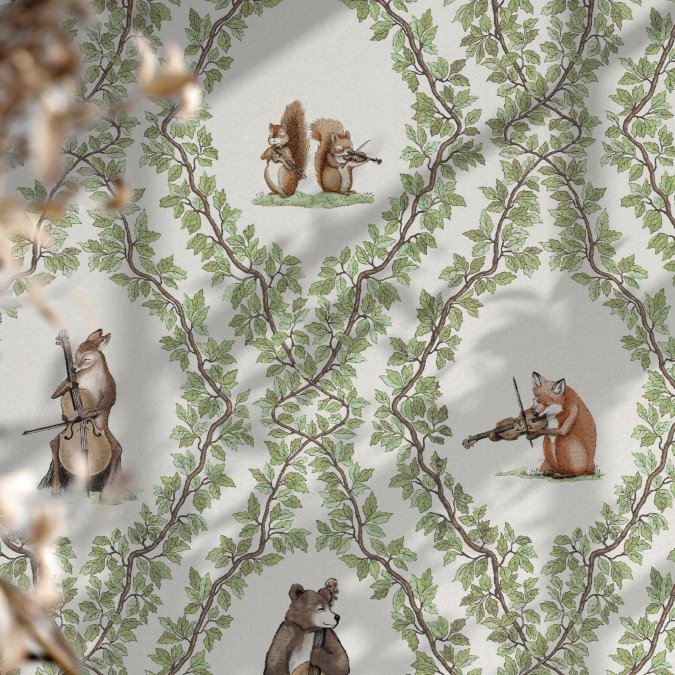
As a child I ran through the deep woods of the Hiawatha National Forest. As I grew I played instruments in ensembles. There was no classical music playing in those forests, but somehow the peace that I felt was so similar. It was like the leaves were whispering in the trees and percussion crunching on the ground, birds sang and all around me was a lullaby of peace. This is the heart behind my Woodland Animal Lullaby wallpaper print that you see pictured here.
Artistic Wallpaper vs Mass Market: What You're Really Choosing
The honest answer is that you're choosing between two different things, not two versions of the same thing. And I don't think the difference lives where people usually say it does. It isn't about price or taste. It's about how the pattern came to exist, and what happens to a room when the thing on the wall was made by someone paying attention. Also, small studios can’t afford to buy large inventory “hoping” that a pattern will become popular. So, we print “Print-on-demand” a process that produces your art after you place an order. This Slow-Decorating production process greatly reduces the waste involved in the home decor products you might order directly from an artists’ studio.
The Mechanism: How a Pattern Is Actually Made
A mass-market wallpaper design usually starts with a trend forecast. A studio sketches a motif that fits the season and hands it to a team that refines it for repeatability. The goal is a pattern that prints identically across thousands of rolls. That's not a criticism. It's engineering, and it's difficult to do well.
An artist-designed pattern usually starts somewhere else: with a body of work, a visual language the artist has been building for years. The wallpaper is a translation of that work into a repeat, which means solving a real problem. How do you take something made for a single canvas and turn it into something that tiles across a wall without losing what made it worth looking at?
That translation is where the difference shows up. The pattern has a rhythm that came from a wrist, not a grid. The images came from an experience or feel. A practice of being human offered directly to your homes walls.
The Gap Most Guides Skip: Where the Paper Comes From
Here's the thing I wish more articles about artist wallpaper would talk about. Most guides compare artist wallpaper to mass-market wallpaper on aesthetics alone. Almost none ask what the paper is made of, what the ink is made of, or where any of it comes from. That feels like a strange omission in a category where the whole point is that someone cared about the details.
A few things worth asking any maker, artist or otherwise:
- Substrate sourcing. Is the paper FSC-certified, meaning it comes from responsibly managed forests? Non-woven, traditional paper, and coated products each have a different end-of-life story.
- Ink type. Water-based inks are generally lower in volatile organic compounds than solvent-based inks. If a maker can't tell you what's in their ink, that's information.
- Print-on-demand vs. stock. Printing to order reduces waste from unsold inventory. Printing in runs doesn't. Neither is automatically better, but the trade-off is real.
The Other Thing Nobody Talks About: How the Pattern Makes You Feel
There's a quieter difference too, and it took me a while to name it.
What You're Actually Choosing
So when I say you're choosing between two different things, here's what I mean:
- Mass market: trend-driven, engineered for consistency, printed at scale, replaced seasonally.
- Artist designed: original artwork, printed in smaller runs or to order, and usually traceable back to a person you could email.
How to Style Whimsical Nursery Wallpaper Without the Room Feeling Busy
The trick is restraint everywhere the wallpaper isn't. Pick one feature wall, keep the rest quiet, and let the pattern be the loudest voice in the room. Really you can let the pattern of the wallpaper do the heavy lifting, adding character and atmosphere to your room for you!
Scale, Color, and the Quiet Places Your Eye Needs
Pattern scale decides whether a room feels calm or crowded. Large-scale motifs on one wall read as a mural; the same motif on all four walls is pattern drenching. Pull two or three shades straight from the wallpaper and repeat them in plain textiles. Nothing else needs to match.
Wallpaper That Holds Up to Real Childhood
There's a child’s “autograph” on our bathroom wall. My son drew it when he was six, and I blotting at it for ten minutes before I realized I was erasing a memory. I stopped. The autograph stayed. But I could stop because the paper underneath was sturdy enough that the scrubbing hadn't wrecked it. This is because in high traffic or demand areas it is best to choose a smooth pre-pasted wallpaper like I have in my bathroom.
What Actually Works When Something Happens
A few things I've learned by trial and error, and by asking people who install wallpaper for a living:
- Fresh marks: blot, don't rub. A clean damp cloth and a drop of dish soap, working from the outside of the stain inward.
- Crayon and pencil: a little warm water first. If that fails, mild dish soap. Save specialty cleaners for last.
- Grease or food: diluted water and white vinegar on a cloth, then a clean-water wipe. Test a hidden corner first.
- Scuffs from furniture: often the finish, not the paper. A soft eraser can lift a light scuff if you go gently.
- Anything worse: this is why you keep a spare roll. Buy the extra roll. I know it feels wasteful. Buy it anyway. Patching one panel beats re-papering a wall, and dye lots change between print runs.
The Room Your Child Will Grow Into, Not Out Of
Here's the objection I hear most: will she still like this in three years? Maybe not the same way. But there's a difference between a theme and a world.
Why Choose Artist Designed Wallpaper: The Questions Worth Asking
Before you decide, ask the questions.
- Who made this, and can I see their other work? A coherent body of work is the best evidence of artistic integrity you'll get. Even better if they share their creative process with you.
- What is it printed on, and how do I clean it? Ask about surface finish and installation technique before you buy, not after.
- Can I order a sample first? Always. A screen lies about color.
- What's the return policy? A fair one tells you the maker stands behind their production partners. But since small studios print-to-order a refund isn’t possible on made-to-order items, unless the items arrive damaged or defective.
- Will it work with what I already own? It usually can. A single feature wall mixed with your existing collected pieces often lands better than a whole-room overhaul.
Conclusion
Some evenings I still stand in the doorway of my son's room after he's asleep, and I notice he’s surrounded by things people made. I hope the village of grandmas, aunties, friends and artists gives him a village of love that holds him even as he sleeps.
Frequently Asked Questions
What makes artist designed wallpaper different from mass-produced prints?
Artist designed wallpaper starts with an original illustration or painting. That means the pattern has intentional details and brush marks. When you choose artist designed wallpaper, you are choosing a specific hand and a specific story, which is why the room tends to feel collected rather than decorated.
Will whimsical wallpaper feel dated in a few years?
Trends move fast, but nature-inspired imagery tends to hold. Leaves, moths, wildflowers, and woodland creatures have appeared in homes for centuries because they echo something children already notice outside.
Can I mix At the Cottage wallpaper with decor I already own?
Yes, and honestly, mixing usually looks better than a fully matched set. If you already have a crib, a rug, or artwork you love, bring those into the room first and let the wallpaper respond to them. Pull one color from the pattern into a pillow or a framed print, and leave the rest alone. Our character pillows and art prints are designed to sit alongside pieces you already have, not replace them.
How do I know the wallpaper will hold up to a toddler?
Look for a wipeable surface finish and ask about installation technique before you buy. Most quality wall coverings can handle a damp cloth and mild soap for the occasional crayon incident, though you should always test a small hidden area first. If your child is particularly enthusiastic about markers, consider wallpapering one feature wall rather than the whole room, so the high-traffic areas stay easier to manage.